
 Tahlia Tsama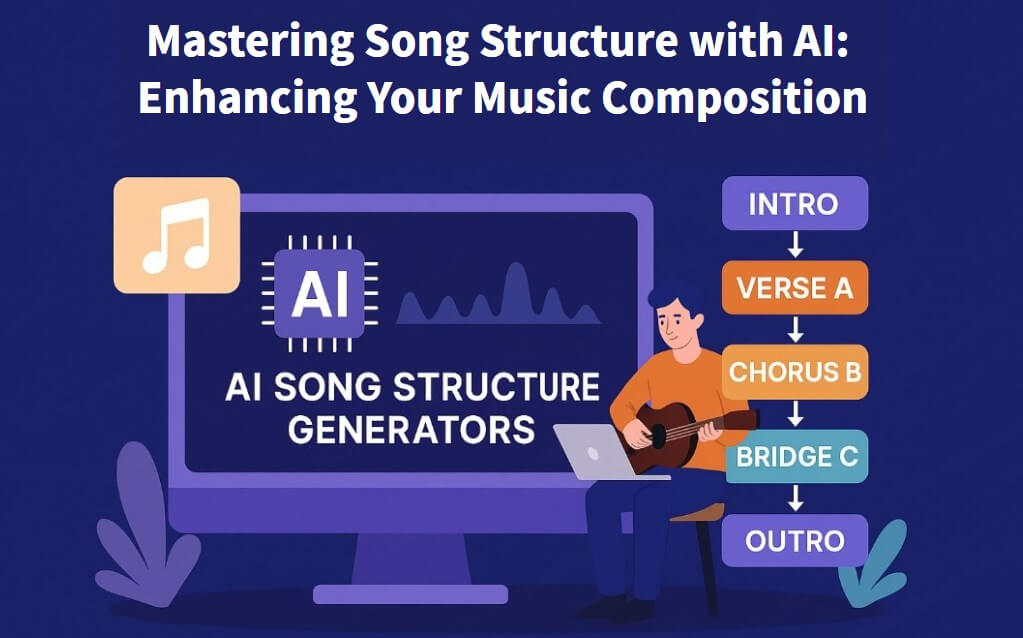
Imagine composing a full song structure in minutes, not hours. With cutting-edge AI tools for building song structures, that’s no longer science fiction—it’s today’s reality for musicians, producers, and songwriters worldwide.
AI Tools for Building Song Structures: The New Era of Music Composition

The music industry is undergoing a seismic shift. What once required years of training, studio time, and collaboration can now be initiated with a few clicks. AI tools for building song structures are empowering artists to break creative barriers, streamline workflows, and explore new sonic territories. These tools don’t replace human creativity—they amplify it.
How AI Is Reshaping Music Creation
Artificial intelligence has evolved from a futuristic concept to a practical tool in music production. By analyzing vast datasets of songs across genres, AI can identify patterns in chord progressions, lyrical themes, rhythm, and song architecture. This allows it to generate coherent and emotionally resonant song frameworks.
For example, AI models trained on Billboard charts can predict what makes a song catchy or commercially viable. This data-driven insight helps artists craft songs that are not only creative but also strategically structured for listener engagement.
- AI analyzes millions of songs to detect structural patterns.
- It identifies common transitions between verses, choruses, and bridges.
- Machine learning models can suggest optimal song lengths and key changes.
One notable example is Amped Studio’s AI Music Generator, which uses deep learning to propose full song arrangements based on user input. It’s a prime example of how AI tools for building song structures are becoming accessible to independent artists.
The Role of Machine Learning in Song Architecture
At the heart of AI-powered song structuring is machine learning. These systems are trained on labeled datasets where songs are broken down into sections—intro, verse, chorus, bridge, outro—and annotated with tempo, key, mood, and instrumentation.
When a user inputs a genre or mood, the AI applies this training to generate a structure that fits. For instance, a pop song might follow a Verse-Chorus-Verse-Chorus-Bridge-Chorus pattern, while a jazz piece might favor a more fluid, improvisational layout.
“AI doesn’t compose music—it learns how humans compose and then helps them do it faster and smarter.” — Dr. Emily Carter, AI Music Researcher at MIT Media Lab
Platforms like Sony’s Flow Machines use this approach to generate original compositions in the style of The Beatles or Duke Ellington, complete with structurally sound arrangements.
Top 7 AI Tools for Building Song Structures in 2024
The market is flooded with AI-powered music tools, but not all are equally effective at constructing full song frameworks. Below is a curated list of the most powerful AI tools for building song structures, each offering unique features for different types of creators.
1. Soundful: AI-Powered Song Structure Generator
Soundful stands out for its intuitive interface and genre-specific templates. Whether you’re working on EDM, hip-hop, or ambient music, Soundful uses AI to generate complete song structures with intros, build-ups, drops, and outros.
- Generates full-length tracks with coherent structural flow.
- Allows users to customize section lengths and transitions.
- Exports stems for further editing in DAWs like Ableton or FL Studio.
What makes Soundful exceptional is its ability to maintain energy dynamics across sections—something many AI tools struggle with. It’s ideal for content creators and YouTubers who need royalty-free music fast. Learn more at Soundful.com.
2. Amper Music (Now part of Shutterstock)
Amper Music was one of the pioneers in AI-driven music composition. Though now integrated into Shutterstock’s audio library, its legacy lives on in its robust song structuring capabilities.
Users can select mood, genre, tempo, and duration, and Amper generates a full arrangement with logical progression. It’s particularly strong in cinematic and corporate music, where structural clarity is crucial.
- Dynamic section transitions based on emotional arc.
- Supports real-time adjustments to structure.
- Seamless integration with video editing software.
While Amper no longer operates as a standalone platform, its technology powers Shutterstock’s AI music generator, which remains a top choice for structured audio creation.
AI tools for building song structures – AI tools for building song structures menjadi aspek penting yang dibahas di sini.
3. AIVA (Artificial Intelligence Virtual Artist)
AIVA is designed for composers who want AI assistance without sacrificing creative control. It specializes in orchestral, cinematic, and classical music, offering intelligent suggestions for song structure based on classical composition rules.
Using a neural network trained on works by Beethoven, Mozart, and John Williams, AIVA can generate symphonic arrangements with proper development, climax, and resolution.
- Follows traditional music theory in structural design.
- Allows users to edit individual sections or regenerate them.
- Supports MIDI export for integration with notation software.
AIVA is particularly useful for film and game composers who need emotionally impactful scores with well-defined acts. Explore its capabilities at AIVA.ai.
4. LANDR’s AI Songwriter
LANDR, known for its AI-powered mastering, has expanded into song creation with its AI Songwriter tool. It helps users build song structures by suggesting chord progressions, melodies, and lyrical themes.
What sets LANDR apart is its focus on collaboration. Artists can input a melody or lyric, and the AI will suggest a full structure around it, including where to place the chorus or bridge.
- Generates song blueprints based on user-provided motifs.
- Offers genre-specific structural templates.
- Integrates with LANDR’s mixing and mastering suite.
It’s a powerful tool for songwriters stuck in creative ruts. More info at LANDR.com.
5. Boomy: Instant Song Creation with AI
Boomy is built for speed and simplicity. In under a minute, users can generate a full song with a complete structure—verse, chorus, bridge, and outro—across genres like pop, lo-fi, and synthwave.
The AI learns from user feedback, improving suggestions over time. Songs can be released directly to Spotify, making Boomy a favorite among indie artists and social media creators.
- One-click song generation with structural integrity.
- Community voting system improves AI training.
- Direct distribution to streaming platforms.
While not as customizable as other tools, Boomy excels in rapid prototyping. Visit Boomy.com to try it.
6. Udio: AI-Powered Music with Advanced Structure Logic
Udio is one of the newest entrants but already making waves. It uses a large language model approach to music, interpreting text prompts like “a sad indie rock song with a quiet verse and explosive chorus” to generate structurally rich compositions.
Unlike earlier tools that generate loops, Udio creates full narratives with dynamic shifts in intensity and instrumentation.
- Text-to-music generation with structural awareness.
- Supports multi-part arrangements (intro, verse, pre-chorus, chorus, etc.).
- Allows fine-tuning of individual sections.
Udio’s ability to understand emotional arcs makes it one of the most advanced AI tools for building song structures. Check it out at Udio.com.
7. Google’s MusicLM and AudioLM
While not yet consumer-facing, Google’s research in MusicLM and AudioLM represents the future of AI in music. These models can generate high-fidelity audio from text descriptions and maintain structural coherence across long durations.
MusicLM can create a 2-minute song with a clear verse-chorus structure based on a prompt like “a cheerful synth-pop track with a bouncy bassline and a catchy chorus.”
AI tools for building song structures – AI tools for building song structures menjadi aspek penting yang dibahas di sini.
- Generates music with semantic and rhythmic consistency.
- Preserves structural elements across time.
- Still in research phase but available via limited demos.
For developers and researchers, Google’s open-source releases offer a glimpse into next-gen AI tools for building song structures. Learn more at Google AI Research.
How AI Tools for Building Song Structures Enhance Creativity
There’s a common misconception that AI stifles creativity. In reality, AI tools for building song structures act as creative catalysts. They handle the mechanical aspects of composition—like timing, key changes, and section transitions—freeing the artist to focus on expression and emotion.
Overcoming Creative Blocks
Every songwriter faces the blank page syndrome. AI tools can jumpstart the process by generating a basic structure. From there, the artist can modify, expand, or reinterpret the AI’s suggestions.
For example, a generated chorus might inspire a new lyrical direction or a different melodic approach. The AI doesn’t write the song—it provides a foundation.
- AI generates initial ideas to break creative inertia.
- Artists retain full control over final output.
- Speeds up the ideation phase significantly.
Democratizing Music Production
Not everyone has access to formal music education or expensive studio equipment. AI tools for building song structures lower the barrier to entry, allowing anyone with a laptop to create professional-sounding music.
This democratization is especially impactful for underrepresented voices in the music industry. With AI, a teenager in Nairobi can produce a track that competes with studio-quality releases from Los Angeles.
“AI is the great equalizer in music. It doesn’t care about your background—only your ideas.” — Maya Chen, Music Producer and Educator
Understanding the Technology Behind AI Song Structure Generation
To truly appreciate AI tools for building song structures, it’s important to understand the underlying technology. These systems rely on a combination of deep learning, natural language processing, and audio signal analysis.
Neural Networks and Sequence Modeling
Most AI music tools use recurrent neural networks (RNNs) or transformers to model sequences. In music, a sequence could be a series of chords, notes, or structural labels (verse, chorus, etc.).
Transformers, popularized by models like GPT, are particularly effective because they can capture long-range dependencies—essential for maintaining coherence across a 3-minute song.
- RNNs process music as a time-series data stream.
- Transformers use attention mechanisms to focus on relevant sections.
- Both can predict the next segment based on previous ones.
For instance, if the AI detects a rising melodic line in the verse, it might predict a climactic chorus, mirroring human compositional instincts.
Symbolic vs. Audio-Based AI Models
AI tools for building song structures fall into two categories: symbolic and audio-based.
Symbolic models work with MIDI or sheet music data, focusing on notes, chords, and structure. They’re excellent for generating editable compositions. AIVA and Amper use this approach.
Audio-based models, like those in Udio and Google’s MusicLM, generate raw audio waveforms. They offer richer sound quality but are harder to edit post-generation.
- Symbolic models: High editability, theory-aware.
- Audio models: High fidelity, less editable.
- Hybrid systems are emerging, combining both strengths.
Customizing AI-Generated Song Structures for Your Style
One-size-fits-all doesn’t work in music. The best AI tools for building song structures allow deep customization so artists can imprint their unique voice.
AI tools for building song structures – AI tools for building song structures menjadi aspek penting yang dibahas di sini.
Adjusting Tempo, Key, and Dynamics
Most AI generators let users set basic parameters like tempo (BPM), key, and time signature. Advanced tools go further, allowing control over dynamics—how loud or soft each section is.
For example, you might want a verse that starts piano (soft) and builds to a forte (loud) chorus. Tools like AIVA and LANDR support these dynamic markings, ensuring emotional progression.
- Set BPM and key before generation.
- Adjust volume curves and intensity per section.
- Modify instrumentation to match genre.
Editing and Rearranging Sections
After generation, most tools export to DAWs (Digital Audio Workstations) where artists can cut, loop, or reorder sections. This is crucial for tailoring AI output to personal taste.
Some platforms, like Soundful, allow in-browser editing, letting users drag and drop sections or change their length without leaving the app.
“The AI gave me a chorus I never would’ve written. I changed the lyrics, kept the melody, and it became the hook of my hit.” — Jordan Lee, Indie Artist
Challenges and Limitations of AI in Song Structuring
Despite their promise, AI tools for building song structures aren’t without limitations. Understanding these challenges helps users set realistic expectations.
Lack of True Emotional Intelligence
AI can mimic emotional patterns but doesn’t feel emotion. It learns that minor keys are often sad and major keys happy, but it doesn’t understand grief or joy.
This can lead to structurally correct but emotionally flat compositions. Human input is still essential to infuse authenticity.
- AI relies on statistical patterns, not lived experience.
- Emotional depth requires human storytelling.
- Best results come from human-AI collaboration.
Copyright and Ownership Issues
Who owns a song created with AI? This is a legal gray area. Most platforms grant users full rights to generated music, but the training data often includes copyrighted works.
For example, if an AI generates a melody similar to a Beatles song because it was trained on their music, could there be a copyright claim? The answer isn’t clear yet.
- Check platform licensing agreements carefully.
- Some tools offer commercial use rights.
- Legal frameworks are still evolving.
The Future of AI Tools for Building Song Structures
The evolution of AI in music is accelerating. What we see today is just the beginning. The future promises even more intelligent, adaptive, and collaborative tools.
Real-Time AI Co-Writing Partners
Imagine an AI that listens to your guitar playing and suggests a chorus melody in real time. Future AI tools for building song structures will act as live collaborators, responding to your input during jam sessions.
Companies like Spotify and AI Music Lab are already experimenting with interactive AI musicians.
- AI responds to live input with structural suggestions.
- Integration with smart instruments and wearables.
- AI learns from user’s personal style over time.
Personalized Style Replication
Future AI tools will be able to analyze an artist’s entire discography and generate new songs in their signature style—with consistent song structures, lyrical themes, and sonic textures.
This could revolutionize how legacy artists release new music or how fans experience “new” songs from retired musicians.
AI tools for building song structures – AI tools for building song structures menjadi aspek penting yang dibahas di sini.
“AI won’t replace artists, but artists who use AI will replace those who don’t.” — David Liu, Tech Futurist
As these tools become more personalized, the line between human and machine creativity will blur, leading to a new era of hybrid artistry.
What are AI tools for building song structures?
AI tools for building song structures are software applications that use artificial intelligence to generate or assist in creating the framework of a song, including verses, choruses, bridges, and outros. They analyze musical patterns and user input to suggest coherent arrangements.
Can AI-generated songs be used commercially?
Yes, many AI music platforms grant commercial rights to users. However, it’s essential to review each platform’s licensing terms, as policies vary. Tools like Boomy and Soundful allow direct monetization and distribution.
Do I need musical training to use these tools?
No, most AI tools for building song structures are designed for beginners and non-musicians. They feature intuitive interfaces that require no prior knowledge of music theory.
Can AI tools replace human songwriters?
No, AI tools cannot replace human emotion, storytelling, or cultural context. They are best used as assistants that enhance creativity, not replace it.
Are AI-generated songs copyrighted?
The copyright status depends on the platform. In most cases, users own the rights to the music they generate, but the AI’s training data may involve copyrighted material, creating legal complexities.
The rise of AI tools for building song structures marks a transformative moment in music creation. From Soundful to AIVA, these tools are making it easier than ever to compose structurally sound, emotionally engaging songs. While challenges remain—especially around emotion and copyright—the benefits are undeniable. As AI continues to evolve, it won’t replace artists; instead, it will empower them to create more, faster, and with greater innovation than ever before. The future of music isn’t human or machine—it’s human and machine, working in harmony.
AI tools for building song structures – AI tools for building song structures menjadi aspek penting yang dibahas di sini.
Recommended for you 👇
Further Reading: